Majel الماجل
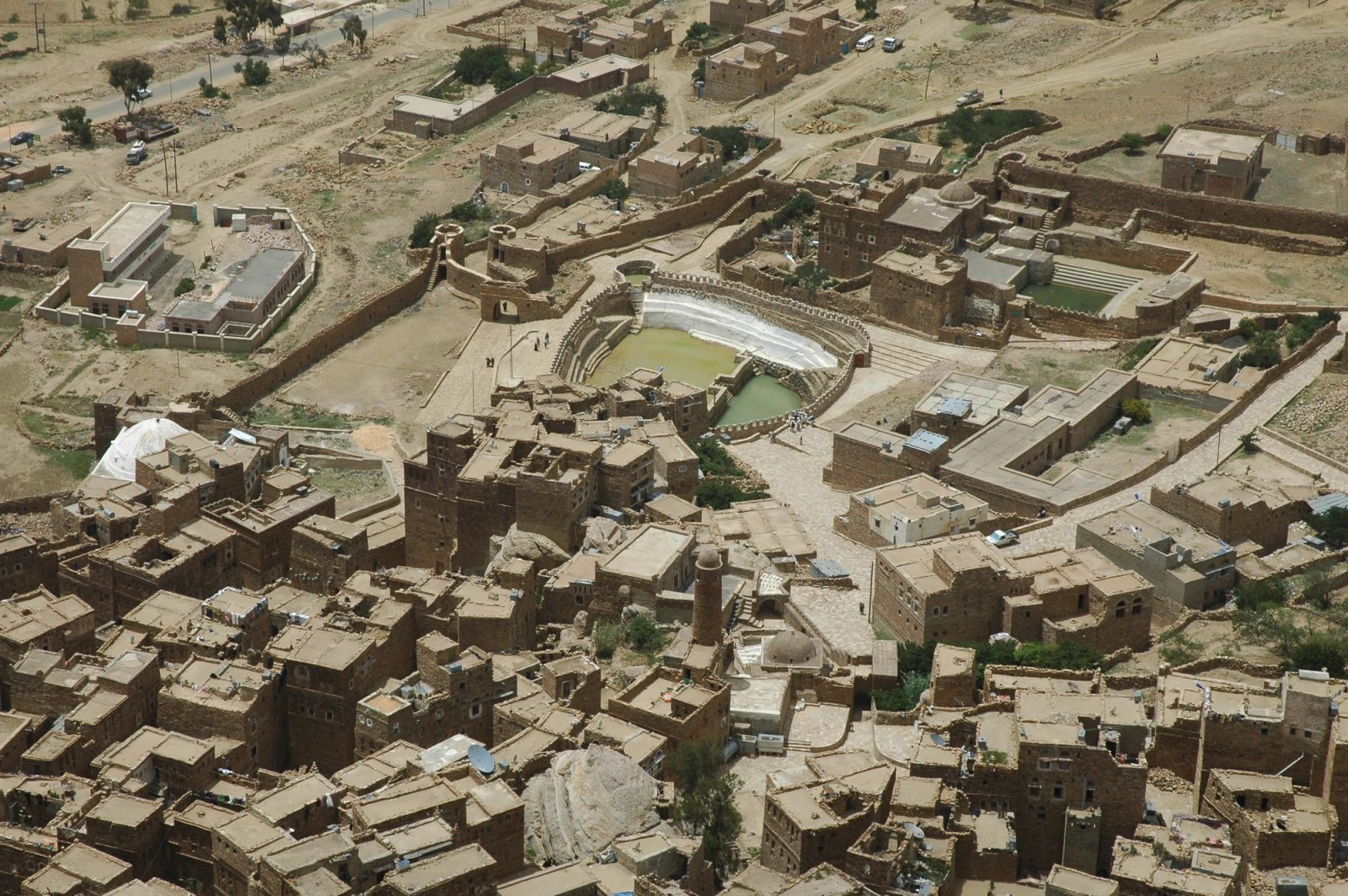
In the summer of 2006, under the direction of Professor Morna Livingston for a series of books on the architecture of water retention, we were involved in the analysis of rural mountain cisterns in Yemen. The work centered on the practice of continuous building, generational projects that in some instances lasted for centuries. The cisterns, essential spatial artifacts that collect water in a very dry part of the world, were maintained and adapted through uninterrupted use. The transference of knowledge and building techniques, many of them ancient, was our primary source of investigation.
06.06.06 - flight over the Atlantic
On Metro North somewhere between Stanford and South Norwalk, lulled by a familiar boredom, looking out at the passing word through a sun-stained and scratched acrylic window, locked into the numbing practice of externalized observation; external in that it requires the mind to float to the surface and act as a filter, a scrim, not as the conscious agent that attempts to harvest meaning from the mess of things; the mind as a passive processor of image streams, sometimes interconnected, but often not; disjointed observations of the built environment, the subtle differences between concrete drums supporting trusses and those supporting rail cables, the ubiquitous components of overlapping systems, rail ties and nails, transformers, cables and coils, and other things that repeat themselves over and over but no name comes to mind; and the equal lack of vocabulary when confronted by all the bushes and vines and trees and weeds clamoring for space along the edges and cracks of hard places. To be a filter, a processor of a world that no matter where you are is constantly revealing layered changes, grades and transitions, individuals and collectives, individuals among collectives. It is not easy to block out introspection when in this act of external sifting. The mind wants to relate immediately to the previously processed, felt, or thought, to form syntheses, but in doing so misses a larger trajectory of transient events, the rhythm of seemingly unrelated instances that flutter past or freeze and vanish. Velocity matters. If you move too fast, the eye is muddled by the monotony of larger things. Blurred smears of indistinguishable, greenish brush in the margins, the sky, the asphalt as a sinuous road or an unbending straightaway. It is the stillness of artificial flight that cramps the mind with nothing to see at 30,000 feet except pale cloud cover. Might as well be locked up in a padded cubby. Wilfred Thesiger moved through the desert at a camel’s pace. He noted the way the dromedary’s weight transformed the sand, revealing layers of multicolored granules otherwise obscured by the lighter, less dense grains that shifted and maintained themselves topward by the wind and the laws of gravity - a silky sheet of khaki. He not only had the time to see the camel's feet momentarily displace this geological pecking order, revealing long-obscured red and even deeper black sand, but also the slow restoration of that nature, the receding reds and blacks going back to their depths, each with their own angles of repose. Everything returning, always light and bare. He saw a black beetle on the sand. He saw it scuttle until it became a black point, until it was consumed by the static of sand and the layer of trembled motion lingering on the horizon. I read all of this years ago near the end of my stay in Turkey and Uzbekistan, a trip that marked the beginning of my adult life. Samarkand was a name tied to a historical narrative. I partially unfolded the name into an actual place in my mind. Yemen, for me, has no narrative that I can relate to. That’s my ignorance. I carry it with me. No Mimar Sinan, no Kervansaray, no Tamerlane, no turquoise tiled domes immaculately restored by Soviet archeologists. And although the mud brick towers of Sanaa and the port of Aden somehow connect in a web of references, it's the sands and the Bedou and the beetle that I can't shake. All that emptiness in the Empty Quarter. But if it were only that, then I would be far from anxious or even fearful. I would be eager to unfold the name into a place as I did years ago in Central Asia and Anatolia. I’ve changed and the world seems to have changed as well. For one, I'm not alone. At the airport I told her that I felt more vulnerable simply because we have each other now, because we have a new dimension of loss. She told me that we also have our strength, together; that we are each other’s compass. And then there is the irrational, which new forces around us reconstitute as truth. Towers fell. I saw towers fall and smelled the acrid dust as it moved up the avenue followed by dusty people with hollow faces. The Arab world, Islam. These constructs are employed in a new currency of weaponized fear. Blind fear. But are we not at war? It’s not my fucking war. Will I not be perceived by many where I am headed as a representative of the aggressor, the hegemon, the enemy? Is it only because I feel I have more to lose or because I am older and perhaps more attuned to the global drama that the world feels vivid and volatile? Or is it actually more hostile than at any other moment in my life? Everything points to the latter. I sense a downward slide. This is change, violent and abrupt, and that scares me. So I'm off to Yemen, fearful, but also eager to do what I tell myself life is about, seeing and learning and feeling through direct observation, experience, and empathy. And then, of course, doing something with all that mess, the ethical dimension of the thing itself, which is, as of yet, unclear to me.
08.06.06 - Sanaa
I'm sitting on the terrace looking down at the empty plot below covered with a scrabbly, sage-colored undergrowth interrupted by the bent figure of a single palm leaning over a wall. Beyond is the city and although I am only afforded a narrow view corridor flanked by mud brick and plaster homes much like the one I am in, I can see that the rest of the city is made of the same stuff and extends in the same dun hue, with brief exceptions of lighter modern constructions in grey concrete and the occasional billboard bracketed on rooftops. Further beyond the city's edge, the silhouette of a tall peak, brown and craggy, fades in the haze. I face the wind blowing from the north and with it comes the sounds of car horns, bike horns, whistles, and for a moment a woman singing from the street. My room is small, so small that I can reach and touch every wall with little effort from my bed. I’m convinced the combined volume of the thick walls around my cell probably add up to the volume of the space itself. Thermal mass. The building preserves whatever cool it can during the day, and in the afternoon when the sun drops and the north wind passes through, the windows cleanse the house. What is the name of the wind? It has to have one. It must. It is regular and punctual, and for that it has to have a name. I didn't see enough of the city to have an idea of its rhythm, its pulse, but could still identify familiar themes and motifs to places I've been to before – Bukhara, Mardin, Urfa, Aleppo, Ramallah – barbershops, blue jeans on torsoless mannequins, dried fruits of comparable varieties neatly packed and piled in orderly market stalls, arrays of electronic stores and photo labs and vulcanizers, and the mingling of cars, motorcycles, bicycles, and pedestrians like slow moving lava. However, the men here have knives curling around their belts, and the women are black shadows. Tomorrow, we're off on our first trip. I don't know where or in what direction. I'm not yet consumed by my environment, nor am I alone. Yes, perhaps that has something to do with it. Morna seems agreeable enough, although abuzz with a nervous undercurrent. I can sense her waiting for me to acclimate. I found out that I will most likely sleep with the other men in our team wherever we find lodgings. The children are everywhere, even when you don't see them you can hear them at play.
sabah al-khayr صباح الخير, sabah al-nur صباح النور, sabah al-yasmine صباح الياسمين
– good morning (morning of goodness, morning of light, morning of jasmine)
09.06.06 - Shibam
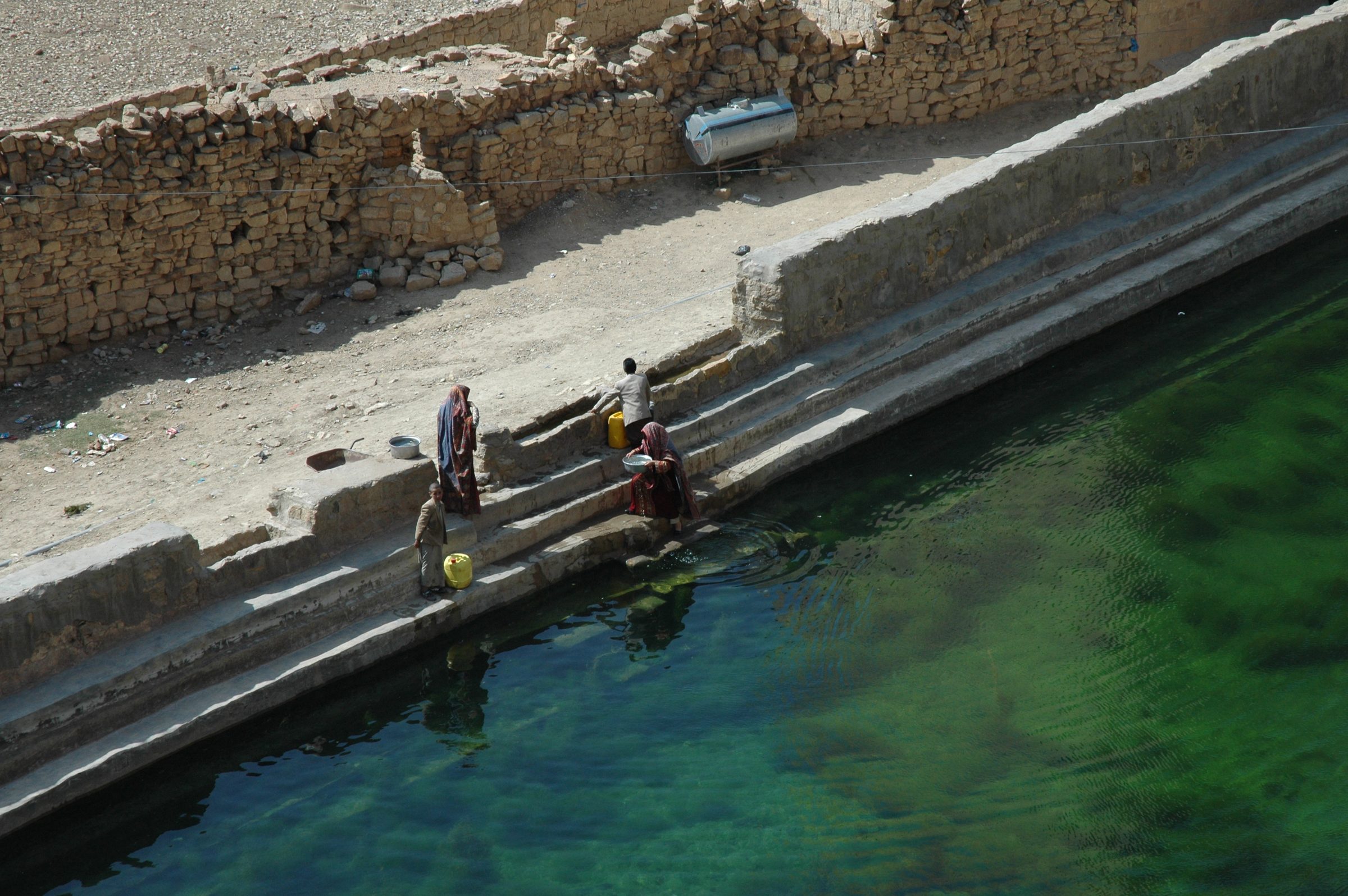
Yahya and Nabil picked us up on al-Bamia. To complete the party, we were joined by Isa Ali, a mild-mannered archaeologist, and Ahmed, a tagalong government functionary sent to monitor our work. Ahmed’s loud, raspy voice and hectoring directives were his way of reminding us that our enterprise was at the pleasure of the government. Within a day, his imposing affectations quickly waned. The tedium of the work itself made him lose interest in the project as a whole. Unnoticed, during the second day, he was gone. He unceremoniously hitched a ride back to the capital without a word. The road from Sanaa to Hababah reminds me of childhood trips out of Mexico City towards Puebla or Veracruz during the dry seasons, serpentine ascents with views of arid quiltlike plains and garbage everywhere. Qat fields and field stone walls marking nothingness; occasional waddis with a wretched settlement or a transient market; rocks piled here are there to make room for other things; mounds of men and boys on the beds of pickup trucks; checkpoints with mustachioed military wearing odd camouflage, the green too chemical, the browns too dull. Yahya turns on the radio where it seems like every sentence ends with Amerikiya. We stop and smoke, and I ponder tilled land that seems impossibly dry. Morna concentrates on the compass. We arrived at Hababah, round a bend of rubble and trash, through the city gates past man-children, snot-nosed and looking half wise, half dead. It's as if all the elements of the medieval city as I would expect it are in place, the gate, the wall, the huddled homes, except that this is a wrecked, otherworldly vision of the same sedentary needs. Hababah is at once splendid, then squalid, then splendid again. The tower houses surrounding the cistern are irregular and misshapen and full of ornament. Stone fascia becomes horses, screens, and cornices. Doors and window frames are whitewashed in lime accents. The children arrived immediately and were to stay with us, swelling and dispersing throughout the day. The girls don't swim, or as Nabil says, “don't play, don't say no, don't go to school, don't go out, we will explain this to you.” No one noticed when a woman filling her bucket fell in and was quietly drifting, quietly drowning. Moments later, she was saved by a few boys nearby who noticed ripples in the emerald pool’s otherwise placid surface and jumped in to find her sinking behind a low wall, her garments billowing in the water like a jellyfish. When they pulled her out her wet sitarah, normally filling out a gumball silhouette, stuck to her body, revealing a frail and gangly figure. The children reek of smoke, leather, and dusty, sweat-layered scalps, Their eyes are roomy, the corners of their mouths come to dry white wrinkles that crack and cake as they speak. Measuring a curved wall proved a painful exercise in reminding myself the basics of high school geometry and trigonometry. Several smart boys huddled around my sketching seemed to understand exactly what I was doing. We are reminded to be vigilant of rampant ignorance and forget to notice intelligence everywhere around us. An old man of obvious importance greeted us at the mosque, white beard, shemagh elegantly wrapped around his head with a strand of green millet sticking out like a plume. Was he the imam or the town dandy? Both, perhaps. We measured the mosques, taking intermittent breaks during prayer. With Yahya's murmured communion and the beautiful language that surrounds me, I feel closer than ever to understanding just how little I know or understand. Yahya slept in the mosque, his head resting on rolled carpets while we finished measuring column grids and located sculptural niches in elevations. By the end of the first day, I was already getting the hang of it. The work turned into a meditative flow, a dialogue between the body of a place and the paper of my book; Ali, Nabil, and I speaking to each other in a numerical language of lengths, heights, and depths. Lunch was like entering a roadside inn from my childhood memories of Asterix comic books, floor upon floor of rooms for eating. The fare is prepared in a smoke-blackened kitchen that resembles a mechanic’s garage. Hunks of gamey mutton boiled; a piping hot stone bowl with frothy fenugreek; eggs cracked in to cook in the steaming broth; ground lamb and rice; a yogurt and herbs mixture on a bed of sourdough. It feels natural to rest my grimy eating paw on my folded knee, upturned fingers curled and sticky with bits of lunch cemented to them. I tasted qat for the first time. The small green leaves numb my cheek. Like memories of unripe guayabas in Colombia, the taste is instantly sweet, then alkaline and bitter, and finally astringent, leaving the inside of your lips senseless and dry. It rained twice for an instant and by the late afternoon my bare feet felt cold. An entire day in a dusty town focused on rocks and water, surrounded by hapless waifs. I'm exhausted. We’re staying above a bakery on an intersection of roads in Amran. It's good to be alone and clean in my fluorescent room. I stay connected to home with quick phone messages. The short missives are brief but necessary interruptions to this alteruniverse.
hajar حَجَر – stone
jabal جبل – mountain
12.06.06 - Shibam
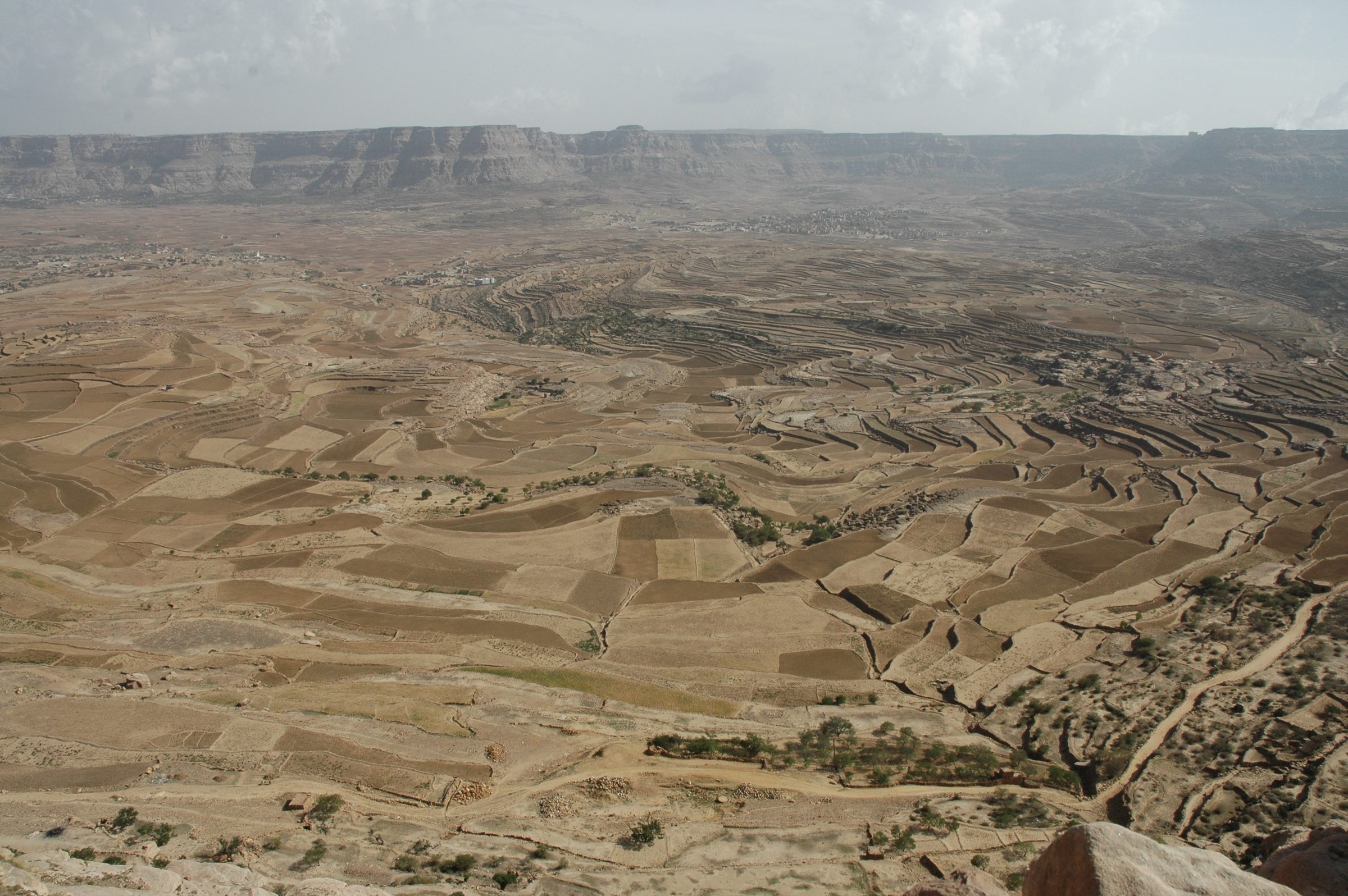
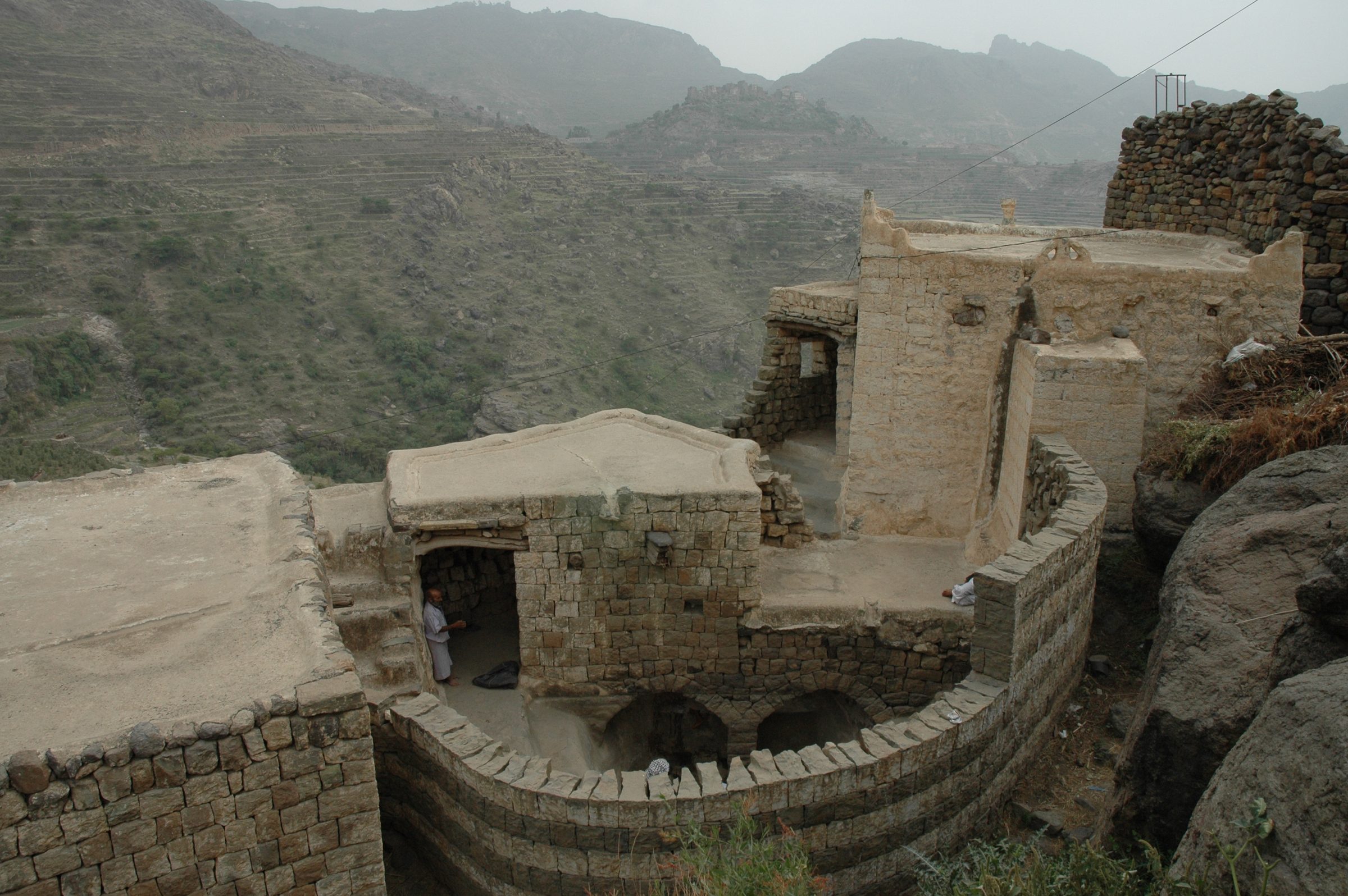
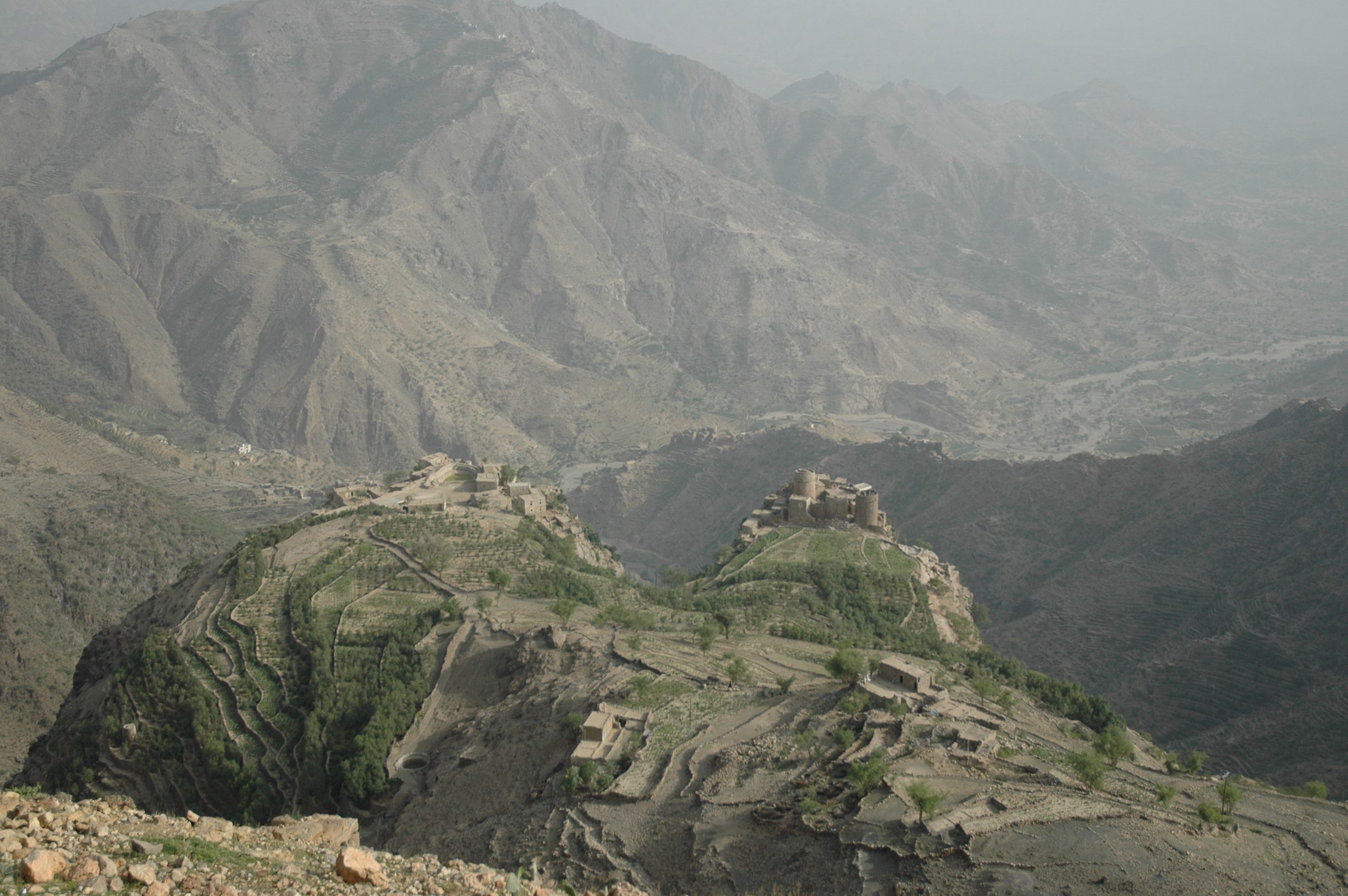
My first concern is that I don't have bed bugs in my bed or, for that matter, lice in my hair. The day started in the dregs. The task at Hababah graduated from a mere mathematical challenge into something altogether different, altogether overwhelming. Today, the garbage seemed to be piled in higher heaps along the road. The dogs seemed wilder and more desperate, the men more rabid, slinging Kalashnikovs over their shoulders, clutching their curved jambiyas, which can either seem intimidating or utterly ridiculous depending on the wielder. I’ve seen barely adolescent boys, children really, wearing these knives, preventing them from stooping, kneeling, much less walking properly. And the guns and the rifles. So many weapons. The world can seem grotesque and flawed. We make it so and then seek redemption in the indifference of nature, confusing the stillness of the peaks and high mesas for some message of transcendent fellowship with things beyond ourselves. On that desperate road between Shibam and Hababah where dogs stand over garbage-speckled hills like jackals and greasy men emerge from sooty garages holding the remains of mechanical carcasses, I saw an eagle, huge and brown, shifting as it crossed us low on the lane, its head turning in one direction, its wings in the other. Everything changed then. The road opened some as we climbed towards the plateau and the grain fortress of al-Zakati. In this part of Yemen the plains are contained by enormous projections of rock, not quite close enough to seem interdependent, as in a chain, but more like giant shepherds encircling a minuscule flock of ants. The fort sits on top of a rock digit, a giant “OK” thumb pointing upwards from a clenched fist.
15.06.06 - Thulla
We are measuring an old külliye, for lack of a better word: a mosque, a turbeh, a pool and a hamam, a medressa with sleeping quarters rimmed on one side by an old city wall. As I draw and record dimensions in the courtyard between the mosque and the pool, a man prays next to me while his small child, a toddler of no more than three, stands by his side waiting for him to finish. The grain fortress of Thulla looms overhead from the rock. The man kneels to the ground. I am close to his prayers, his utterances are like sighs that fade off in the raspy back of his throat. Eagles and doves and crows linger, gliding with slight adjustments in their layer of sky. We're waiting for lunch. There's peace here. We are invited again to eat in someone’s home. Earlier in the morning, Osama and Mohamad, both no older than ten or eleven, volunteered to show me around the fortified walls and the best way to get on and off the domed roof of the mosque. Osama and his kitten in his pocket, Mohammad and his lengthy explanations about God and the mountains, or so I gathered. The tower houses of Hababah were dark warrens with fibrous walls where light, entering through small apertures, was suspended on particles of dust and the air carried the dense smell of animals and the chatter of women mingling out of sight. There, Ali and his children took us to his rooftop and showed us hospitality, but only after he had wrangled himself free from a crazed argument in the morning between him and his neighbors, all vying for the honor of hosting our delegation. The diwan here in Thulla is brightly lit by large windows with stained glass panels at the edges that filter the sun in patches of color over textured carpets. I am back at chewing qat with Nabil and Isa, each time taking a bit more in my cheek. Although I'm still waiting for the full amphetamine wave to hit, I nevertheless feel time sharpens to a point soon after the leaves stimulate my salivary glands. Besides the occasional bitter swallow, the taste is pleasing and, more importantly, I feel like I'm part of the team. We ate our lunch with the host's curious and mild mannered children while he looked on from the other side of the room, waiting for some gesture of approval from his guests, all of us dipping our hands in the same tins of rice, chicken, and potatoes. My days are paused by cigarettes. I will smoke and sit and contemplate the measurements ahead with Isa.
raha راحة – rest