Stari Most
A City Divided:
The Architecture of Monumentality in Postwar Mostar
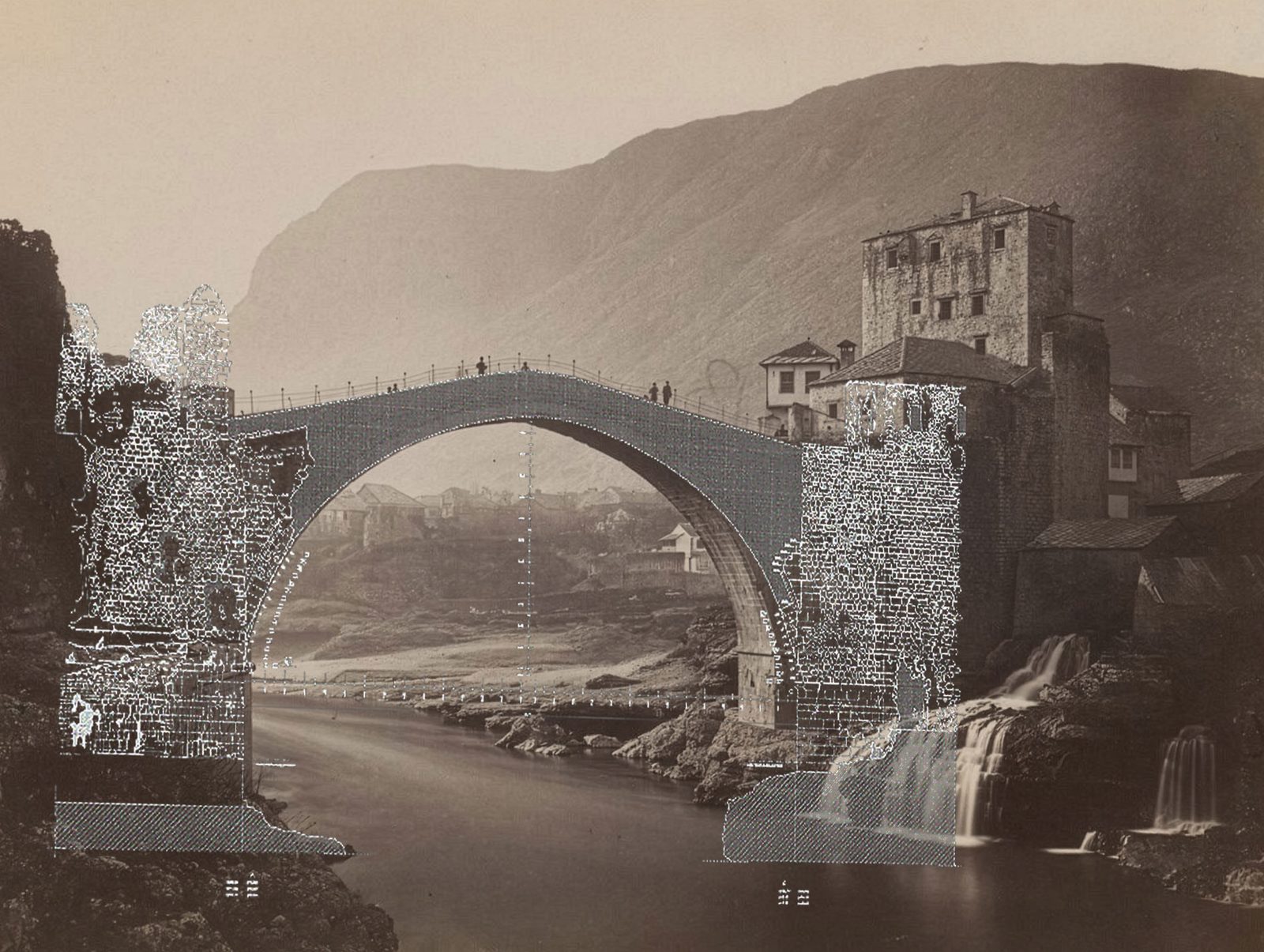
The war in Bosnia left Mostar pocked and shattered with many of its monuments in complete ruin. Subject to two separate sieges, it was arguably the most heavily damaged city in the war. When Serbian military units were finally repelled in the spring of 1992, the Old Bridge (Stari Most), considered a sixteenth century Ottoman masterpiece and the unrivaled symbol of a city long known for its multicultural heritage, was shrouded in sniper-torn blankets supported on a makeshift scaffolding. Tires knotted together with heavy rope were strung over the balustrade to buffer the impact of artillery fire from the hills above the city.
In May 1993, the ‘Croat Defense Council’ (HVO) had their turn at besieging Mostar. Already war-torn, the city suffered a second wave of destruction. On November 9th, HVO forces positioned on the west bank of the Neretva River opened fire on the bridge. Its springline was hit at point blank range by a tank shell. The Stari Most collapsed in a plume of smoke as it fell into the river. Seen as the culmination of a series of acts of vandalism, since by that point the bridge served no strategic purpose and merely allowed for civilians to cross and transport the dead and the wounded, the destruction of the Old Bridge has to be understood as something more than a casualty of war. The typical identification of this destruction would be a targeting of the ethnic patrimony of a particular group by another. But as Andrew Herscher reminds us, it would be based on an “a priori identity between buildings selected for attack by one side in the conflict and buildings regarded as patrimonial or monumental in the other.” It would ignore the discrete act of destroying, which is less about the “destruction of the putative ethnic or national identity of its victims than as the construction of an identity on the part of those who carry out this destruction.”
Subsequently, in the case of Mostar, it also becomes a question about the construction of identity through a process of rebuilding. Beginning in 1998 under the auspices of UNESCO, the World Bank, the World Monuments Fund (WMF), and the Aga Khan Trust for Culture (AKTC), an international effort to rebuild not only the fallen bridge but large parts of historic Mostar was under way. In 2004, nearly a decade after hostilities between Croatian and Bosnian political factions formally came to a close (although informally, ethnic and politically motivated violence continued well into the nineties) the reconstruction of the Old Bridge was complete. Today, Mostar’s historic district, spilling primarily from the bridge on the east bank appears to have effortlessly purged all trace of war. The Stari Most, with its two immaculately re-fitted guard towers allows one to imagine the place as it must have been shortly after its completion over four centuries ago.
As if petrified, the mahalla (neighborhood) with its rows of pale limestone houses and characteristic Ottoman eaves characterize a piece of a city nearly lost. A slow trickle of more adventurous tourists taking day-trips from the Dalmatian coast are now arriving in Mostar by car and bus. From the main roads signs lead them to parking lots paces away from the bridge. Clad in sandals, they cross with trepidation, negotiating the slippery limestone steps that follow the Stari Most’s steep arch. The steps, recovered from the river bed and polished to a shine, appear at once worn and remarkably new. At the top of the bridge, gathering crowds wait for young men in speedos to emerge from the guard house. Balanced on the balustrade, the young men dive into the Neretva amid cheers and cries. On the other bank old magazines open to the street sell Afghan carpets woven in China, inlaid wood backgammon sets from Damascus, cheap reproductions of Iznik tiles, and plaster models of the Old Bridge. Outdoor cafes with low-lying furniture blast electronic music and invite passersby to take a break from the heat. In this hermetically rebuilt environment, historic Mostar allows Europeans on their beach holiday to wander into a slice of the old Orient in their own backyard.
Along Mostar’s main streets, however, the contrast between shell-ridden buildings and new construction serves as a reminder that the war ended a mere twelve years ago. It is precisely this contrast between the historic, the new, and the decrepit that creates conflicting images of the city. Emily Grunzberger defines the urban identity of Mostar as balanced between many ‘cities’ in a single site. As alternating visions of Mostar as a ‘Croat city’, a ‘divided city’, or as a ‘model city’ compete for primacy, various building projects, beginning with the reconstruction of the Stari Most, reflect an increasingly confused if not caustic environment. Perhaps the most sobering example of this building trend is a set of recently completed edifices on the western half of the city that inevitably make their overwhelming presence felt. From nearly every vantage point one cannot help but notice a monumental Latin cross perched on a hill. The Jubilee Cross, measuring over fifty feet in height, rests on Hum Hill, a strategic high ground for Croatian and Serbian batteries during the war. As if to compliment the cross, the concrete campanile of the new Franciscan cathedral towers well above almost every building. Once seen as a multicultural urban paragon in former Yugoslavia, Mostar is now a city divided in half along the river. With the Serb community reduced to less than 3% of the population, the western bank is largely populated by Croats while the eastern bank is primarily Muslim. Seen in this light, the two Catholic monuments emerge as confident provocations from a city split along religious and ethnic lines.
Through an analysis of the Old Bridge – by looking at both the impulses that led to its destruction and the desires that led to its reconstruction – as well as an account of new architectural symbols that have emerged in the last decade, this essay hopes to illustrate how Mostar’s built environment serves as a barometer of competing political, social, and cultural claims. To begin with, the bridge must be seen as an edifice that represents a complex layering of cultural ambitions. As a symbol, the bridge has to contend with other symbols that are poised against what it represents. While the cross and the campanile share an overt presence in the city and communicate a singular nationalistic ambition, the bridge is composed of conflicting impulses. As a result of the war, the bridge was transformed from a multicultural Mostari emblem into a Muslim icon. Still, many both inside and outside Bosnia continue to use it as a vehicle for reconciliation based on the hope that Mostar will return to a state of peaceful coexistence. It would be impossible to say that the reconstruction of the Old Bridge symbolizes a parallel restoration of Mostar to a previous state, uncontaminated by war. The gigantic cross and tower are evidence enough of that. Furthermore, it is not the aim of this essay to collapse the fall of Yugoslavia into a singular moment such as the destruction of the Stari Most. In fact, to use the bridge as a blanket metaphor would fall prey to precisely the kind of gross generalizations that brought about its destruction. The destruction of the bridge, and, for that matter, a long list of other monuments should be seen rather as a symptom of a much larger process of political disintegration and paranoia. Its unmaking and remaking allow us to see it as a repository of conflicting imaginations. It remains to be seen whether an increasingly ambiguous symbol can accommodate such seemingly conflicting desires. Ultimately, we should ask ourselves whether the past can be reconstructed at all.
April 20, 2007
Under the supervision of Prof. Ivo Banac
Yale University, Department of History